

24 February 2026
|
The task of giving a piece of music a certain grade is a tortuous one, says Matthew Mills, who explains the complexities of what makes for a difficult (or easy) score
‘There is no such thing as a difficult piece. A piece is either impossible, or it is easy.’
– Louis Kentner
As a student, I often found myself stuck in waiting rooms full of other aspiring pianists, and for some reason—maybe sizing up the competition—many would gleefully ask: ‘So, what’s the hardest piece you can play?’ I would always reply ‘Mozart K 545’, and would invariably get one of two facial expressions in response: ‘Huh?’, or ‘I know, right?!’
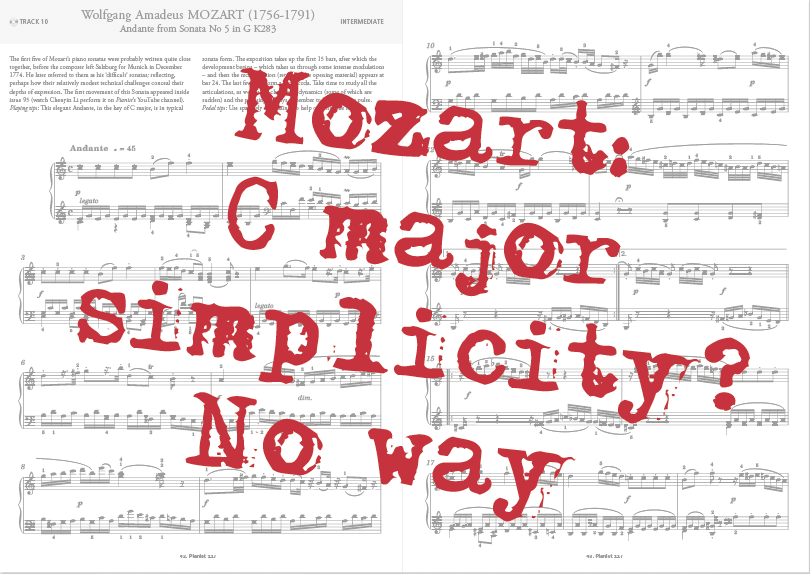
I wasn’t just making a point about the fatuousness of the question. There is a special terror in playing something so well known, and so texturally spare that any slight blemish will immediately be apparent. As Schnabel famously said, ‘the sonatas of Mozart are unique; they are too easy for children, and too difficult for artists’ and I, for one, ain’t gonna argue with Schnabel!
Grades and difficulty
It is, of course, vital for us to progress as pianists and musicians to tackle works that challenge us now and then. Striving to overcome new difficulties forces us to grow musically and technically. In order not to bite off more than we can chew, though, we must refine Kentner’s easy/impossible dichotomy and ‘grade’ pieces according to their ‘difficulty’. Exam boards do this every time they publish a new ‘set works’ list for their syllabuses. The process of assigning particular works to particular grades is a complex, nebulous back-and-forth between syllabus directors and examiners, and even then, they don’t always get it right. Often music publishers or retailers have their own broader categories to help customers make a suitable purchase. Within each of these groups, though, there often seems to be a wide range of works which at first glance encompass varying degrees of technical or musical challenge.
Key is indeed a factor in difficulty, but one which is actually part of a more general issue
Reading music and playing music are different processes but, in most cases, are taught in tandem. Tutor books generally focus on teaching rudimentary notation through playing; mechanics are rarely mentioned, and only enough notation is explained to be able to play the pieces contained within the tutor books themselves. Once the student has graduated from method books, they might follow a graded theory course, exam-based or otherwise, or their teacher might explain notational concepts as the need arises. The result is that most students can play music they can barely read, or to put it another way, most students’ repertoire is limited by their literacy as much as it is by their technical capacity. As a result, some pieces can look harder than they actually are and, conversely, some can appear deceptively straightforward.
The length of a piece is worth noting
Many young students are initially put off something longer—’What?! Three pages?!’—but a single-page piece can sometimes contain much more challenging, and less repetitive, material. Schubert, for example, thinks in quite large musical units, which usually means you’re often repeating entire paragraphs, possibly in different keys, rather than playing completely new material. While performing a longer piece might require more sustained concentration, that concentration isn’t always so intense as in a shorter, trickier work.
Some composers are easier to play than they look
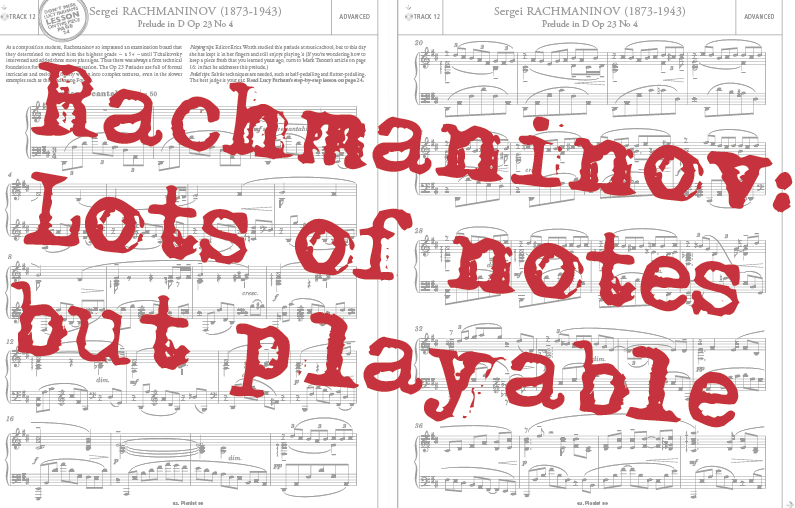
Never one to shy away from bold statements, I shall hereby declare: Rachmaninov is harder to read than it is to play. Please, hear me out. Like many accomplished pianist-composers, little Sergei Vasilyevich loved notes. He loved to play lots of them, and so he wrote lots and lots of them: big chords, wide arpeggios, complex textures with lots of interweaving contrapuntal lines, decorative figuration. It’s great to play, but only the very best sight-readers have even the slightest hope of digesting all of it at the required tempo. The rest of us have to learn it, because it just goes by too fast to read. Rachmaninov writes generously for two hands each possessing just five digits. Given his own superhumanly large span, it’s actually rather pragmatic and—speaking as someone who struggles to reach more than a ninth—very playable by regular-Joe hands. Working out what to play, however, can be quite a time-consuming process.
How the notes feel under the hand
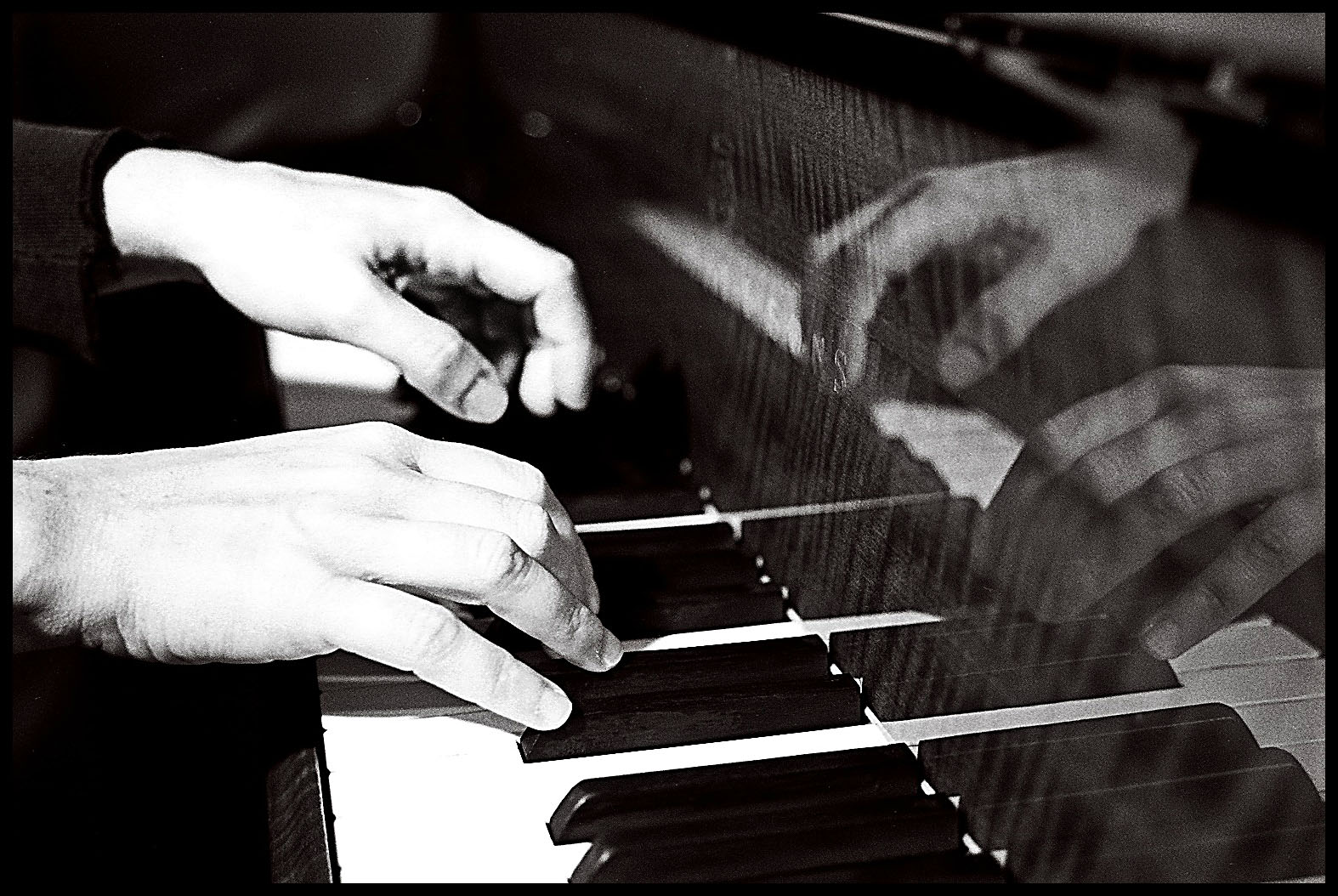
Returning to the subject of key, another fairly decent pianist-composer, Frédéric Chopin, started his students off with a scale of B major. He understood that that pattern is the one best suited to the shape of the hand. This ‘ergonomic’ approach, ‘black-note’ keys being hand-friendlier than ‘white-note’ keys, is one of the reasons Romantic music often has ‘bigger’ key signatures. Many, if not most, of the works of pianist-composers began life in improvisation, so tend to feature ideas that lie quite naturally under the hand. Classical keyboard style, on the other hand, often emulates orchestral or chamber music textures, and the keys used reflect the dominance in this period of stringed instruments, whose open string tunings most naturally fit keys of up to three or four sharps, and are generally happier with sharp keys than with flat ones. Baroque style is entirely focused on the musical idea: instrumentation was almost always flexible, so composers had little or no concern for the music’s technical demands.
Keys and accidentals
The graded exam system’s introduction of scales with the fewest black keys first reflects teaching’s notational bias. While C major is the easiest key to read, as it doesn’t require you to remember and make any adjustments to the notes immediately in front of you, it is one of the least comfortable scales for the hand. Notational simplicity trumps pianistic ease. Imagine printing Schubert’s famous Impromptu Op 90 No 3—in G flat major—without a key signature, but using accidentals wherever they’re required. Would it be easier to play? No! Would it be harder to read? Yes! In fact, Tobias Haslinger, who first published the Impromptus, had it transposed into G major, and doubled the number of bar lines (it is in 4/2 time, but he printed it as if it were in 2/2), believing that Schubert’s original key and barring would deter potential customers. Anyone who has played this version will confirm that it is, in fact, much harder to render effectively than Schubert’s original.
Is Romantic repertoire harder?
Music in a Romantic style is inherently more ‘pianistic’ than that in Baroque or Classical styles. This is not a criticism, of course; after all, we can’t blame Baroque or Classical composers for not writing so idiomatically for an instrument that hadn’t yet evolved! This isn’t just about black-key key signatures. The use of the pedal, for instance, is a given in Romantic music, while one can debate the extent to which it is acceptable to pedal Baroque and Classical keyboard music. The archetypal piano sonority relies on the sustaining pedal to create a depth and richness of sound that can’t be achieved with the fingers alone.
Various technique and the size of one's hand
Obviously, once we have come to terms with the appearance of the score, there remains a number of musical devices and techniques that, when used alone or in various combinations, can demand more of us physically and/or mentally: octaves, double-notes, trills, passagework, wide leaps and stretches, and big chords. Of course, at a faster tempo, each of these things becomes even more demanding. Etudes aside, though, very few pieces deploy these devices consistently throughout. A relatively straightforward piece can contain just one or two exceptionally difficult bars.
This is why categories of difficulty can be so controversial, because every pianist has their own view on what is or isn’t challenging. Everybody is different: some hands are narrower, some broader; fingers are longer or shorter, of relatively even length or more pronouncedly ‘long’ and ‘short’, and so on. (Personally, I have a bit of a thing for double notes; on the other hand, tremolandi fill me with horror.) Pianists with larger hands often find the dexterity required of a Bach suite or a Haydn sonata more difficult to achieve than the big chordal writing of early Brahms, for instance. On the other hand, those whose hands are constantly ‘at full stretch’ might find it more tiring to play Schumann, for example, who rarely wrote one note when three would suffice!
To summarise
It is very tough to make a definitive pronouncement on how easy or difficult a piece is. It depends on so many different technical and musical factors, and every pianist will relate differently to the challenges that each piece presents. Regardless of whatever ‘level’ of ability or ambition you may be, if you approach every new piece with open eyes, an open mind, and an open heart, even if you can’t master it perfectly right now, it will enrich you.
Every issue of Pianist magazine contains over 40 pages of sheet music for beginner to advanced pianists: that's at least three beginner-level pieces, a handful of intermediate-level pieces, and then one or two advanced pieces. Take a look at all the back issues!