



As you ponder your pianistic progress, looking for new challenges and fresh motivation, you may consider taking a piano exam. Writer and teacher Matthew Mills says you should definitely give it a go!
If you’ve never taken a piano exam, the idea can be daunting. Especially as an adult (which I assume most Pianist readers are, such wisdom traditionally being denied to the young), the thought of putting yourself on the spot and possibly embarrassing yourself in front of a total stranger might not be at the top of your list of New Year’s resolutions. But here are two reasons why you should, I believe, consider it.
First, an exam sets you a deadline and a clear benchmark to reach. Playing a musical instrument is a lifelong journey of discovery and growth – and this is true whether you start aged six or 60. There is never a point when you can say ‘I’m finished!’ While this is one of music’s greatest joys, at the earliest stages it can also be one of its greatest obstacles. This is where ‘the grades’ serve a useful purpose. They divide the beginner’s journey into manageable and progressive steps and lay out some – but by no means all – of the skills expected of today’s musicians.
Second, the exam will make your playing better, as long as you remember that an exam result is a record of what happened in that room on that day, that it is not a judgement on your potential or ability carved on a stone tablet. I have encountered several successful professional musicians who at some point failed an exam, and also plenty of ‘Grade 8 distinctions’ with less musicality than a tree stump! Confidence comes from both preparation and experience, and because exams require one and deliver the other, they are useful tools in our musical development, regardless of their outcome.
Spice of life
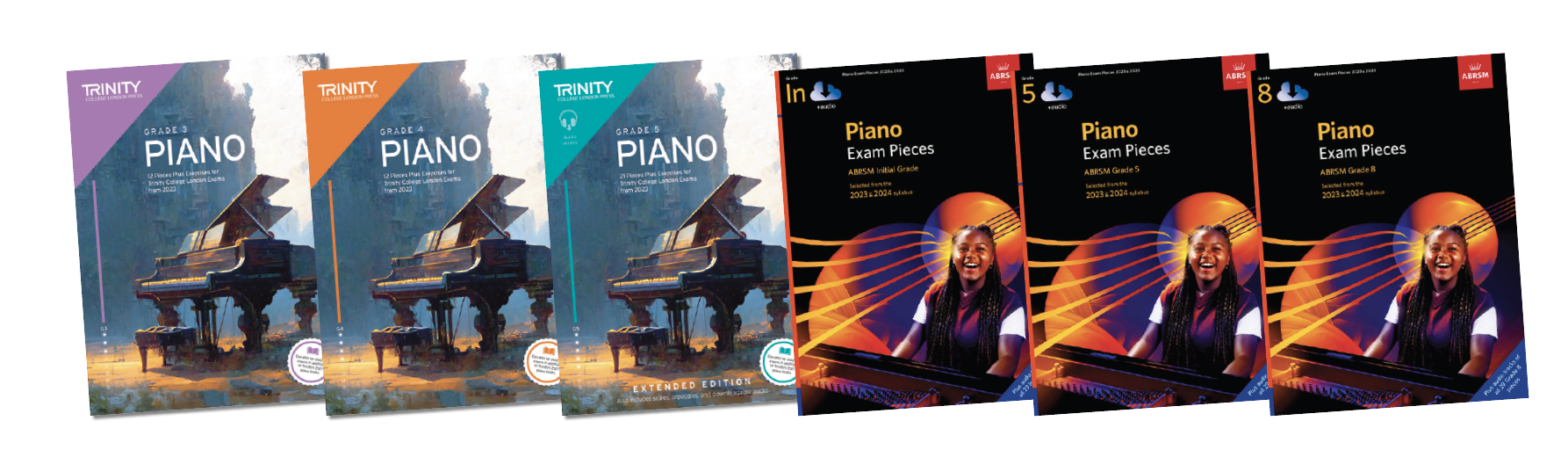
Especially after the pandemic, which accelerated the roll-out of exams taken entirely online, there is a wide range of syllabuses and exam formats available. In the UK alone, the ABRSM offers ‘Practical Grades’ and ‘Performance Grades’. TCL offers ‘Face-to-Face’ and ‘Digital’ grades; the latter with both ‘technical’ and ‘repertoire-only’ pathways. LCME offers ‘Graded Exams’, ‘Recital Grades’, ‘Leisure Play’, and ‘Performance Awards’.
Most traditional in format, ABRMS’s Practical Grades, TCL’s Face-to-Face Grades, and LCME’s Graded Exams require you to play three pieces chosen from a set repertoire list, a selection of set technical work, and take sight-reading and aural tests in an exam room with an examiner. LCME also requires a ‘discussion’. TCL offers improvisation and musical knowledge tests as optional alternatives to sight-reading and aural tests up to grade 5, beyond which sight-reading is compulsory but you can still choose between aural tests and improvisation.
LCME’s Recital Grades require four pieces and a choice between sight-reading and discussion; they can be taken in a live or recorded setting. ABRSM’s Performance Grades, TCL’s Digital Grades (Repertoire), and LCME’s Leisure Play are video-recorded exams, requiring four pieces from the set repertoire lists. Leisure Play exams can also be taken in a live setting. TCL’s Digital Grades (Technical) require only three pieces and a selection of technical work from the face-to-face exam requirements. LCME’s Performance Awards require a video-recorded performance of three pieces from the set lists.
Although the majority of video exams require less or no technical work, the entire exam must be presented in a single unedited take, and the marks available in a face-to-face setting from aural tests, sight-reading, or whatever, are instead allocated to something like ‘performance’ or ‘presentation’ or ‘delivery’. In other words, the entire video is examined, not just the playing of the pieces; how you create atmosphere, how you handle stops, starts, and the silence in between pieces – in a word, your ‘stagecraft’ – is reflected in your result.
With so many options, you’ll definitely find an exam format that suits your temperament, schedule, and musical ambitions and preferences. (Exams are offered in classical and jazz styles, as well as a slightly reduced selection in contemporary popular styles.) So, let’s look at how, once you’ve made your choice, you can go about preparing for the exam in a positive and productive way.
Not all about practising
Your chosen exam format will influence how best to prepare. A video exam will take place in a comfortable environment, on a familiar instrument, and you can make as many attempts as you like to get through the whole programme, and your deadline is flexible. A face-to-face exam will be at a set time in a set location, on an unfamiliar (but decent) piano, and the pace of the exam will largely be set by the examiner.
As always, remember that practising and rehearsing are different processes. Practice is about learning the piece, about making sure you ‘get it right’; rehearsal is about making sure it never goes wrong. Or, to put it another way, the concentration required for practice is more intense; that required for rehearsal is more sustained but less effortful. Of course, both practice and rehearsal must be done regularly.
As much as anything, playing the piano is a physical skill: it really can’t be crammed in the three days leading up to the exam. The transition from ‘practice’ to ‘rehearsal’ can happen nearer to a face-to-face exam than a video recording. For the video, once you can successfully navigate each piece alone, it’s time to consider the order of your programme, and how to create contrast with the performance, how to pace the silence between pieces and create an appropriate atmosphere before each piece begins. (It’s not necessary to play from memory, but if you use scores, do rehearse moving the music onto and off the stand quickly and professionally. It’s not good artistry to sit casually leafing through a book for twenty seconds before you find the right page!)
Mistakes happen
Given that it all has to be right the first time round, begin by sitting at the piano, and rather than ‘practising’, play through one of your pieces, warts and all, then stand up and get on with your life. Once you can do this successfully, experiment with combinations of two pieces, then three, before finally sitting down and playing your entire programme in one sitting. Regardless of whether you’re preparing for a live or recorded exam, this is a really powerful skill. Professionals make lots of mistakes. This might not mean that they play lots of wrong notes, but rather that they don’t play the right ones quite how they wanted to.
Whatever the mistake, a professional will not collapse as a result. Professionalism is as much about handling those things that don’t go perfectly as it is about everything being perfect. Ensure one error doesn’t become three. The more often you practise like this, the more readily you will let go of your mistakes, and the more fluid and effortless your playing will become. This is particularly true of sight-reading, by the way: if you’re constantly stopping to correct things you’ve done wrong, you’re not focussing on what’s coming next, which is an instant flow-killer.
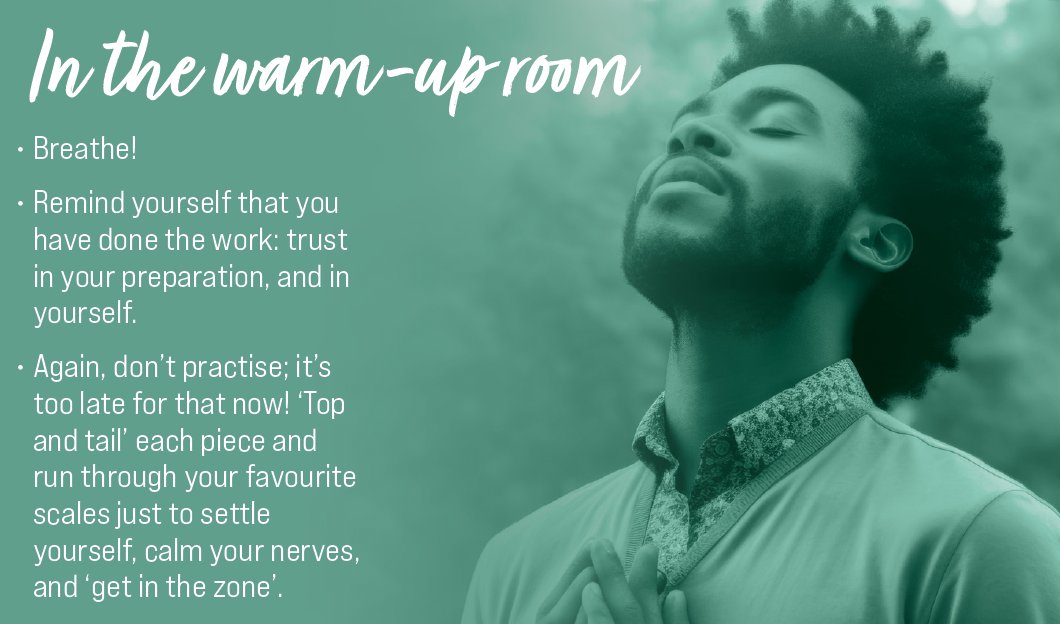
Of course, in an ideal world you would play every note of each piece, scale, and arpeggio flawlessly one hundred percent of the time. This would make you superhuman, and you shouldn’t expect that of yourself. Examiners aren’t just very experienced and well-qualified musicians; they’re also human, and humane, beings. They understand that we all make mistakes, and that almost no-one is untouched by some feelings of nervousness in a performance situation. Your aim, rather than ‘a hundred percent perfection’, should be to give as good an account of yourself and, moreover, the music, as you can under the circumstances.
Face-to-face exams are a series of short, sharp bursts of focus; there will be some ‘downtime’ while the examiner records their impressions. Also, particularly at lower grades, the odd false start or second attempt is usually sympathetically overlooked, provided this is the exception not the rule. Practise using these moments to prepare yourself for what’s ahead, rather than dwelling on how badly you think you’ve just done!
If you’ve entered a face-to-face exam you will know exactly when everything has to be ‘finished’. Given that this format of exam is, as it were, a heptathlon, not a marathon, there’s no need to beat yourself up if some things are less ‘ready’ than others come exam day. Be pragmatic with your allocation of practice time. There’s no point using all your daily practice sessions perfecting a C sharp minor scale in contrary motion only still to be learning the last 16 bars of one of your pieces the night before the exam! Just as it should, the majority of your result will reflect your playing of your chosen pieces, so this is where most of your preparation time should be spent. The mark for each element of the exam, too, is general: one dodgy scale won’t fail your technical section; one awkward bar won’t mean you don’t pass your ‘A-piece’.
Deadlines, deadlines
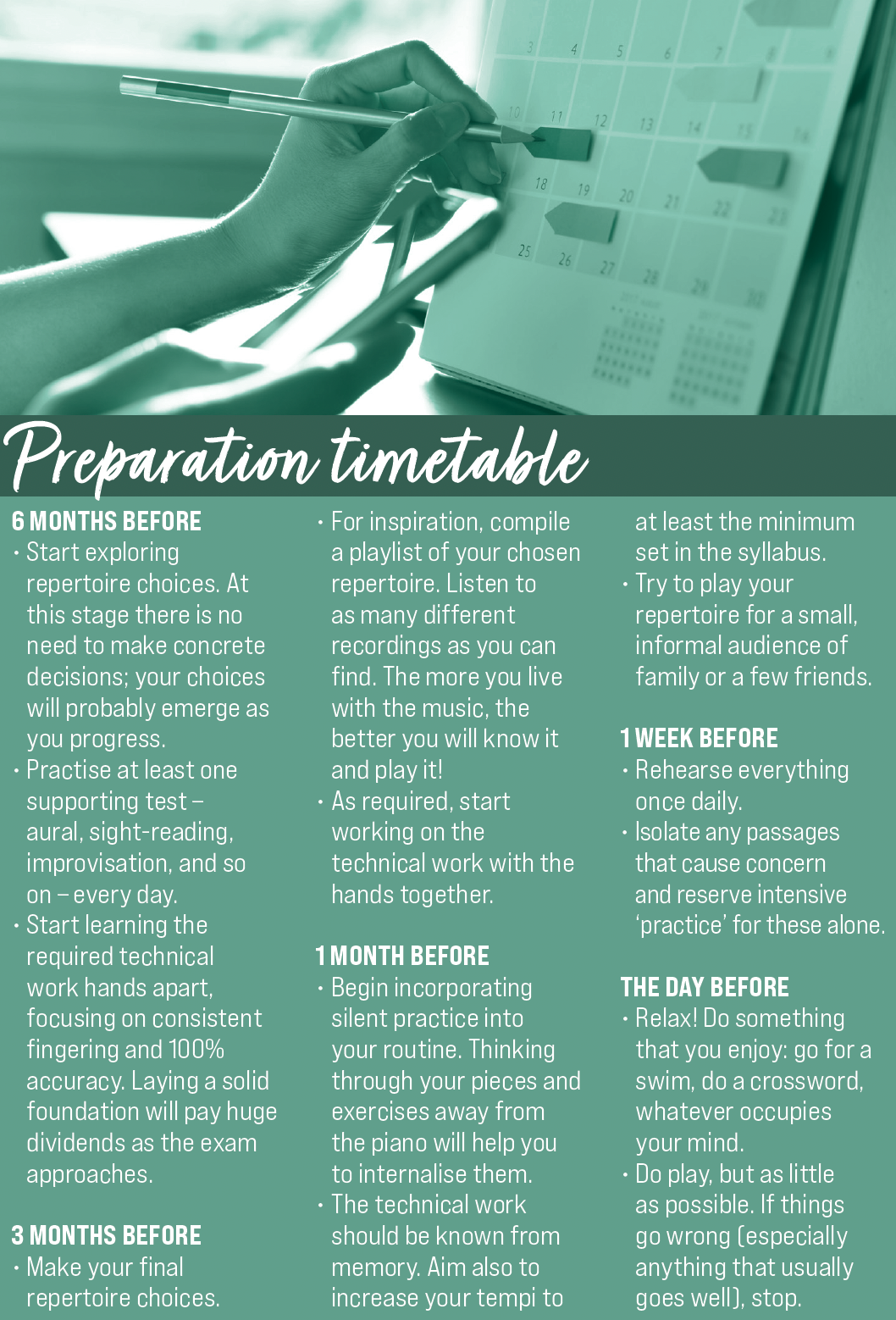
I’m a great believer in checklists. With a plethora of scales, arpeggios, as well as three or four pieces to learn, something can easily slip through the net if you’re not systematic. Divide your time proportionally between all tasks, and move on when the time is up; otherwise you risk getting stuck and using all your time on one thing, then everything else suffers. Try to cover everything as soon and as often as possible. This may seem impossible at first, but as you progress, you will increasingly find that you cover more of the requirements in less time.
While it is beneficial to set a timetable, a plan that’s too detailed and rigid is likely to be abandoned if things don’t happen on schedule. There should be enough flexibility that you can adjust as you go. Set target dates for milestones like knowing scales without the book, playing pieces fluently with the hands apart, and then together, and finally playing each piece end to end at the first attempt. Be ambitious but realistic, and above all allow leeway in your timetable lest something take longer than expected and cause you anxiety.
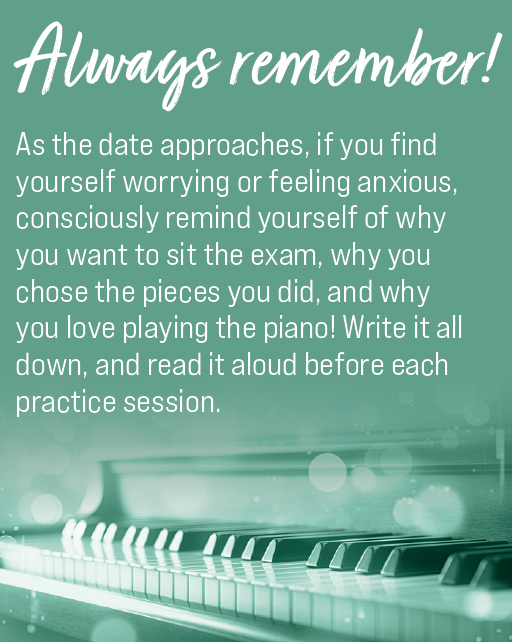
Especially as the date draws nearer it’s easy to fixate on ‘problem areas’ that loom ever larger. Dealing with them is a delicate balance of caring enough that you work hard to ensure you can get through the problematic passage with minimal disruption, and caring so little that you don’t anticipate the issue by rushing the tempo, physically tightening, or otherwise making a challenging task even harder!
One of the teachers of one of my teachers used to say that you never really know a piece until you’ve played it in public 20 times. By then everything that could go wrong will have, so you can relax and just play it. The things that go wrong in performance are rarely those you were expecting to. Knowing that it’s inevitable that things will go differently on the day, rehearsal is also about coping with the unexpected and persevering undefeated and undeterred, come what may. One of the best ways to do this is, of course, to play in front of other people as often as possible. It doesn’t have to be in a formal setting; in fact, a relaxed environment might be better if you have little experience of playing to an audience.
You should also record your practice/rehearsal sessions regularly. Resist the temptation to listen straight away, but leave a few days between recordings and listenings. Listen with your ‘examiner ears’. Is your tempo steady? Is your balance good? Are your dynamics consistent? Are your hands well synchronised? Is your playing enjoyable? If the list of things to focus on is overwhelming, each time you listen choose one or two aspects to focus on. Remember to note things that are good, too.
Of course, most of this advice applies to preparing not only for an exam, but for any performance. This, I believe, is the best way to view an exam – not as a test of your skills, but as a demonstration of your achievements. Who knows? You might enjoy the experience so much that a new year’s resolution becomes a tradition.
Want to really improve your piano-playing skills? Take a look at our very own special publication, Mastering the Piano.